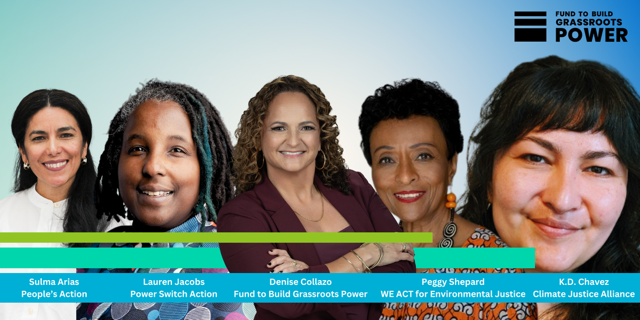
Grantmaking continues to evolve. More and more we’re seeing a shift away from traditional, top-down grantmaking models toward frameworks that reflect the world we want to build – a world that’s free and fair for all. This shift is at the heart of the Fund to Build Grassroots Power (the Fund), an intermediary fund that uses trust-based philanthropy and participatory grantmaking to advance environmental and climate justice in the U.S., Puerto Rico and Guam.
Recognizing the importance of grassroots organizations in building powerful environmental and climate justice movements, the Fund is built on a network model in which four national networks of grassroots organizations – Climate Justice Alliance, the Environmental Justice Leadership Forum, People’s Action Institute and PowerSwitch Action – determine which organizations the Fund will support.
“Each of the networks has its own secret sauce,” explained Denise Padín Collazo, executive director of the Fund. “Their members are on the front lines fighting to close down dirty coal plants and figuring out ways to use wind as renewable energy. They are also thinking about climate refugees and helping to train them in renewable energy work. They’re connecting many dots,” she said.
The Fund prioritizes organizations led by BIPOC and female leaders because they represent the communities that are hardest hit by the climate crises and environmental degradation. In fact, women of color lead all four of the national networks and people/persons who self identify as Black, Indigenous or people of color lead 87% of grantee organizations. This reflects a core belief of the Fund: the people closest to the problem should have the power and resources to change it.
While many grantmakers and philanthropists would say they agree with this statement, the statistics don’t bear out. Data shows that philanthropic money flows unequally to white-led organizations compared to organizations led by people of color, despite the history of long-standing inequities and institutional racism, which means BIPOC communities bear the brunt of the climate crisis and environmental degradation. This is especially true when it comes to unrestricted funding. According to a survey by the Nonprofit Finance Fund in 2022, donations given to white-led nonprofits were twice as likely to be unrestricted gifts, meaning programs can use the money as they see fit.
The Fund to Build Grassroots Power aims to reverse this practice while showing that community-first grantmaking isn’t just the right thing to do — it is more effective. “There is this conversation in philanthropy as if strategic and trust-based philanthropy are mutually exclusive,” Denise explained. “We’re showing that you can do both.” To date, the Fund has granted $25.3 million to 136 organizations. In 2024, the Fund approved an additional $10.1 million in grants to advance environmental and climate justice. Almost all of the Fund’s grantees (97%) reported that the Fund grants helped them build their capacity — from hiring staff, strengthening infrastructure and helping them build more power to ultimately advance environmental and climate justice.
The Kentucky Student Environmental Coalition is a great example. The Coalition engaged students and other community members in opposing a Louisville Gas & Electric (LG&E) pipeline project in Bullitt County, Kentucky, in line with the Coalition’s broader goal to halt the development of new fossil fuel infrastructure. Thanks to support from the Fund, the Coalition mobilized 100 community members to participate in the condemnation case between LG&E and Bernheim Forest, which culminated successfully in the Louisville Metro City Council passing a resolution against the LG&E pipeline.
Windward Fund is proud to be a fiscal sponsor of the Fund to Build Grassroots Power by providing administrative and backend support so it can get resources to organizations quickly. Collazo emphasizes how important this type of grantmaking is, especially right now. “In communities all over the country, really important decisions are being made every single day. These organizations are on the front lines of the movement,” said Collazo. “Given that many groups are busy working on the election, we wanted to give them maximum flexibility with as few hoops as possible,” she said.
In the coming years, the Fund, under Collazo’s leadership, is working to continue to grow the resources available to grassroots groups who fight to advance a just transition from fossil fuels to a regenerative economy. “We are embodying the future in which we want to live,” said Collazo.
To learn more about the Fund to Build Grassroots Power, please visit Fund to Build Grassroots Power.